
# NanoImage vs Squoosh: Browser-Based Image Compression Compared (2026)
Squoosh is one of our favorite tools. It's open source, built by the Google Chrome team, runs 100% in your browser, and has the deepest codec-comparison UI on the web.
So this comparison is a little different. There, the dividing line was philosophical (server vs. client). Here, Squoosh and NanoImage agree on the philosophy — both keep your files on your device. The differences are about *scope* and *audience*.
Disclosure: NanoImage is our project. We use Squoosh ourselves for codec optimization work.
---
TL;DR
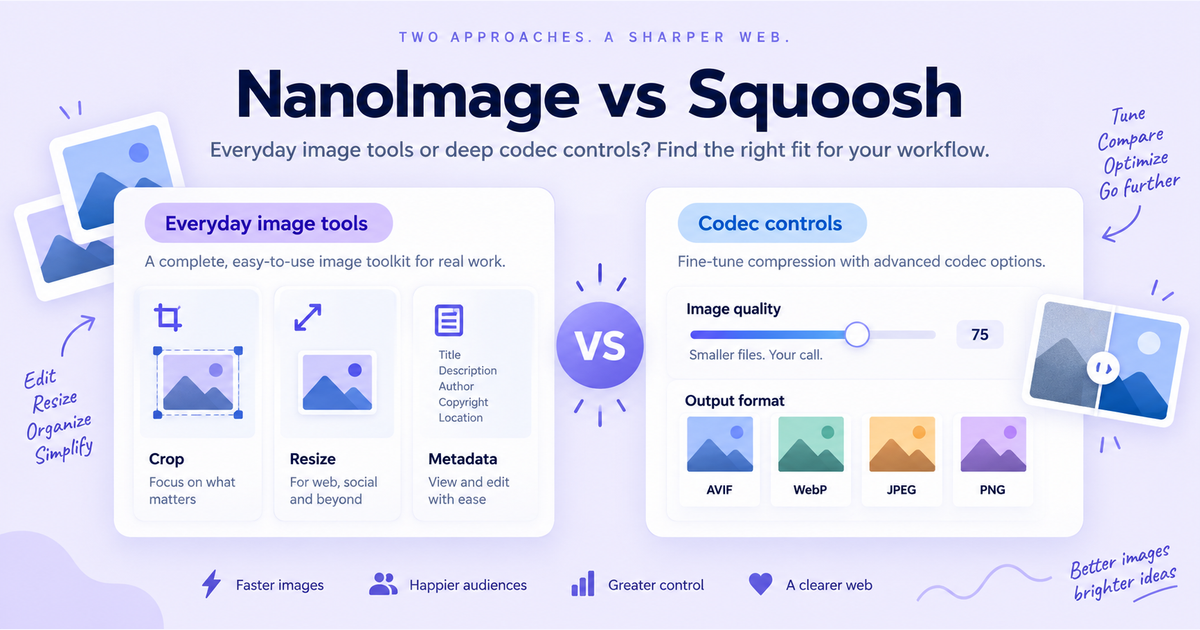
Squoosh is a precision lab for compressing one image at a time with deep codec control. Right tool for hand-optimizing your landing-page hero image.
NanoImage is a 15-tool everyday suite. Right tool when you just need to compress, resize, crop, or convert without thinking too hard.
Use both. They serve different needs.
---
Quick Comparison
| NanoImage | Squoosh | |
|---|---|---|
| Where does compression happen? | Your browser (Canvas API) | Your browser (WASM codecs) |
| Upload required? | No | No |
| Works offline? | Yes | Yes (PWA) |
| Open source? | Partial | Yes (Apache 2.0) |
| Number of tools | 15 | 1 (compression with codec choice) |
| Codecs supported | JPEG, PNG, WebP (Canvas API defaults) | MozJPEG, WebP, AVIF, JPEG XL, OxiPNG |
| Side-by-side codec comparison | No | Yes (signature feature) |
| Batch processing | Yes (up to 10) | No (one image at a time) |
| Crop, Watermark, Meme, Split, Merge | Yes | No |
| Project status | Active development | Maintenance mode (last major release: 2024) |
---
Where Squoosh Wins
1. Codec-level control is unmatched
Squoosh's dual-pane comparison view lets you pick a codec for each pane, adjust quality sliders, and see exactly what each codec produces — file size, visual quality, at the same quality setting and at equivalent file sizes.
If you're optimizing a landing-page hero image that gets 100,000 views a month, the difference between MozJPEG @ 80% and AVIF @ 60% can matter for bandwidth costs and Core Web Vitals.
2. Modern codec support
Squoosh ships AVIF and JPEG XL encoders compiled to WebAssembly. Browser-based tools using only Canvas API (NanoImage included) can't produce these formats today.
3. Open source and auditable
Full source code on GitHub under Apache 2.0. Self-hostable. Verifiable provenance.
4. Built by the Chrome team
Squoosh demonstrates best practices in client-side image processing. The credibility carries weight for enterprise recommendations.
---
Where Squoosh Loses
1. One image at a time
No batch mode. For 30 product photos you need to resize for an Etsy shop, it's an afternoon of repetitive work.
NanoImage accepts up to 10 images at once and processes them in parallel.
2. Compression-only feature scope
Squoosh does one job: compress (with format conversion and resize as side effects). No crop, watermark, meme, merge, or filters.
3. The UX assumes you understand codecs
Terms like "MozJPEG," "advanced options," and "quantization" are friction for non-developers. Many users bounce after 30 seconds.
NanoImage's UX is deliberately the opposite: pick a tool, drop a file, get a result.
4. Project appears to be in maintenance mode
Squoosh hasn't had a major feature release in over a year. NanoImage is in active development; we ship updates every few weeks.
---
When to Use Squoosh
Hand-optimizing one important image (landing-page hero, OG card)
You specifically need AVIF or JPEG XL output
You want a fully open-source, auditable tool
You enjoy fiddling with codec settings
When to Use NanoImage
You need to do more than compression
You have multiple images to process (batch)
You're not a codec expert and want sensible defaults
You're sharing the link with a non-technical colleague
---
The Philosophy They Share
Both Squoosh and NanoImage are 100% client-side. Both keep your files on your device. Both are free. Both work offline. Neither asks for an account, email, or credit card.
---
The Honest Verdict
If you're a developer who wants deep codec control for a small number of important files, Squoosh is the gold standard.
If you want one tool that handles everyday image jobs without making you think about codecs, NanoImage is built for that.
Squoosh is the lab; NanoImage is the workshop.